
Your finance director wants efficiency while your board wants pipeline; the tension between the two is exactly where the strategic potential of a B2B marketing budget often goes to die.
When a B2B Marketing Budget Is Built for Accounting Instead of Growth
In the B2B sector, we’ve seen a recurring conflict where a B2B marketing budget is treated as a static accounting line rather than a dynamic growth asset. You may be facing a scenario where your financial planning requires predictable, monthly pacing, but your market reality demands the opposite. Traditional budgeting focuses heavily on efficiency, but B2B requires demonstrating impact on pipeline, acquisition, and revenue. This rigid approach to spending becomes a liability when you are navigating funding rounds or targeting predictable revenue.
When you manage a B2B marketing budget to hit a number on a spreadsheet rather than managing it to capture a market opportunity, you create a strategic vacuum. We find that many leaders are forced to spend simply because the capital was allocated for that specific month, not because the timing or the channel conditions were optimal for customer acquisition. This misalignment means you are often running outdated strategies for buyer journeys that no longer exist, simply to satisfy an internal reporting cycle.
Why Traditional B2B Marketing Budget Allocation Fails Enterprise Tech
“What we see consistently across global clients is a failure to bridge the gap between marketing activity and investor expectations,” notes Tobias la Cour, Co-Founder of Somebody Digital. “For companies in the $100M+ range, the pressure to justify every dollar of the B2B marketing budget is immense, yet the tools used for that justification are often relics of a pre-AI era.” There is a visible pattern of “safe” spending where budgets are spread thin across too many quarters, which dilutes the impact of major product launches or vertical-specific demand peaks.
In our work across global clients, our team has observed that the most successful enterprise players have moved away from activity-based budgeting. They no longer ask what a campaign will cost to run, but what level of investment is required within their B2B marketing budget to secure a specific volume of the pipeline. If your reporting is still focused on lead volume without a direct tie to CAC, LTV, and MRR, you are likely losing the internal battle for resource priority.
How We Optimize the B2B Marketing Budget for Enterprise Scale
Managed overspend is often the highest-ROI decision a marketing leader can make. When our team has run programmes with enterprise clients, we’ve seen that a controlled overspend of 1-5% on proven, high-performing channels can significantly outperform a strict adherence to a flat monthly pacing of the B2B marketing budget.
“The moment you stop viewing your B2B marketing budget as a limit and start viewing it as a tool for ROI justification is the moment your relationship with the CFO changes,” says Tobias.
We recently worked with a SaaS startup preparing for a Series A round. They needed to prove a scalable growth engine to potential investors, but their spending was too fragmented. By shifting from broad awareness to a targeted performance model and justifying a strategic overspend on their most profitable channels, they secured their funding with a clear, data-backed roadmap for their B2B marketing budget.
Another enterprise software client saw a 20% improvement in marketing-influenced pipeline simply by moving to a flexible budget model. We helped them align their pacing with the actual stages of their long sales cycles, ensuring the B2B marketing budget was available when the buying committee was most active.
“Strategic budget pacing is not about spending less; it is about ensuring every dollar of your B2B marketing budget is deployed where it has the highest mathematical probability of conversion,” says Tobias from Somebody Digital.
The Future of the AI-Era B2B Marketing Budget
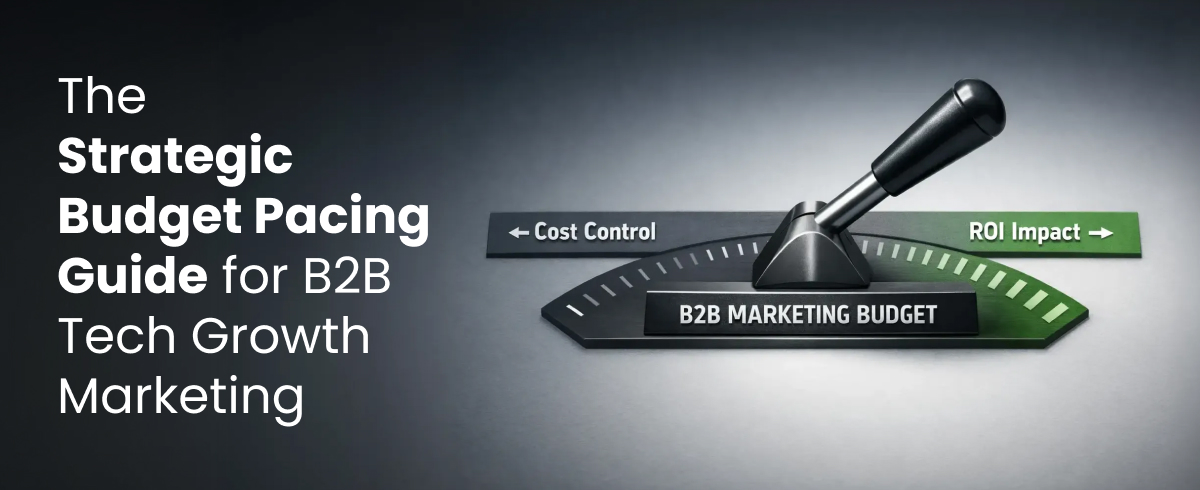
The future of B2B tech marketing belongs to those who build flexible frameworks that support agility. We are moving toward a model where B2B marketing budget pacing is adjusted in real-time based on CRM integration and live performance data. This is what we call building for the AI era: using predictive patterns to front-load spend during key windows rather than following a traditional, linear schedule.
“If your B2B marketing budget framework cannot survive a sudden shift in market demand or a competitor’s move, it is not a strategy; it is just a list of expenses,” says Tobias.
Your evolution depends on scenario planning. You need to develop best, moderate, and conservative budget scenarios that allow you to scale up or down without bureaucratic friction. This level of financial stewardship is now a core requirement for marketing leadership.
Explore our integrated performance marketing services to see how we align spend with growth.
Learn more about our strategic B2B frameworks for enterprise tech.
See our global case studies on scaling $100M+ software companies.
Use performance data from proven channels to show the projected ROI and demonstrate how the additional investment directly shortens the path to your pipeline goals.
Front-loading allows you to capture momentum during key market windows, such as industry events or product launches, where the potential for high-value acquisition is greatest.
For enterprise tech, we recommend a monthly deep-dive review with quarterly adjustments to ensure alignment with real-time CRM data and market shifts.
Focus on CAC, LTV, CAC Payback periods, and the total contribution of marketing to the overall revenue pipeline.
Even pacing ignores the reality of seasonal demand and competitive activity, often leading to wasted spend during low-interest periods and missed opportunities during peaks.
- Aligning B2B marketing budget spend with CAC, LTV, and MRR.
- Implementing target-based budgeting for specific pipeline volumes.
- Utilizing managed tolerance for slight overspend on high-performing channels.
- Integrating budgeting tools with CRM data for real-time tracking.
- Developing flexible budget scenarios for better agility.